
We are back (sort of, its complicated) after a forced extended holiday, due in no small part to the novel corona-virus pandemic. Our classes have been migrated to an online medium for now, this means that this brief and most-likely the next one will depend on us completing them from home. This means that we’re probably gonna have to articulate extremely well using our online mediums, which is something I don’t do particularly well but I will give it my best shot.
This brief entails numbers…. that’s it.
I’m kidding. But also not.
The goal of the brief is to create an experimental website containing 5 separate sections and an about-page that surrounds a quality or aspect of several numbers or a single one, but this brief has a second part to it, in the form of a 2-min explainer video, detailing things like the artistic route taken to create the piece, the scientific/social/psychological information and the design/inspiration scope used to inform the viewer of the process. It’s gonna be quite the challenge, but its going to be interesting.
We had some interesting exercises this morning detailing what we know about numbers, why we personally think they are important, and what we would like to know more about them

I’ve got no mic available to me, so I had to write mine out in detail, which I suppose is actually to my benefit, cause it opens up some of the coolest facts about numbers, both in general but also about a specific number: zero.
15/04/2020
Let me elaborate on the above.
The number system we use currently is actually a result of trade between the Arab traders along the Silk Road and the European Empires. Prior to that, we made use of the Roman Numeral system (I, II, III, IV, V, etc), which was ideal for quantifying large numbers in a consumer-able way for large-quantity trade, which was its primary use. Of course, there were other uses as a number system, but one thing it was not ideal for was scientific formula expression, and as such, the written word was used, which has its own drawbacks, such as the inability to express finely-tuned, precise metrics of any kind, be it weight, distance, volume, curvature, etc.
This change of system led to great deal of innovation down the line… after a couple of innovations. You see, the system was incomplete, and originally had some of the same limitations. The Arab numeral system did not have something that could function as a place-holder. Why is that significant? How do you express anything more than 9 digits if you don’t have a place holder? For traders, this wasn’t so much of an issue because they could assign a word that corresponds to a common metric like 12 as a dozen, and then they can invoke multiples of that metric or a function added to the metric. The word invokes a mathematical function like 9+3 which is a dozen, but how do you do that for uncommon metrics like 13 or if you have to have half of a unit added on to that odd number, or a third of a third added to that number?
The solution came from a Hindu concept, or rather the solution is based upon this concept. The Hindu faith is most well known for the concept of Samara, the circle of infinite death and rebirth in which the material plain exists and on which we technically find ourselves even if you don’t believe that to be the case, only through enlightenment can one be released from the circle. What is beyond the circle? Nirvana, which is technically nothing, but that is because the material plain doesn’t extend in that direction. What is there though, is knowledge and peace, concepts, abstractions. There is nothing, but a lot is expressed there. If you get the metaphor, the plain off the Samsara (Nirvana) is a place-holder for some of the good things experienced in the material plain, and because the Samara is a complete circle, it became the symbol for the mathematical place-holder that the Arab numeral system needed.
15/04/2020 II
So today is supposedly all about finding more info about numbers and potentially finding concepts worth exploring and what people have done in the past with numbers that is exciting, which I’m not gonna lie, is quite challenging. Why? Well, its like saying, “what interesting things have been done with written language?” Nothing spectacular, just every novel, every best seller, every manuscript, every script that actors follow for movies, every architectural motivation, etc was created via the use of words. Don’t get me wrong, numbers may excite some people, and that’s cool. There are numbers that have extraordinary implications for scientists, financial analysts, even architects… but I am a Multimedia Design student (who just passed Higher G Mathematics by the skin of his teeth), I would be lying if I said numbers excited me, a high bank balance at the end of the month, maybe… but otherwise, revisiting the stuff that scored me extra remedial classes on a Saturday is the stuff of nightmares, makes me feel like I’m back in high-school. Numbers by themselves are not gonna peak my interest.
15/04/2020 III
We are gonna have to get more specific than what the brief document gives us, and that is something I’m having a pretty hard time doing. In the zero-draft, I mentioned that numbers themselves are inconsequential without their context, and I think here it definitely applies. I’m aware of some numbers that have heavy significance to the architectural world, numbers that appear constantly in the natural world, and numbers that form the basis of the predictions necessary for the financial world to function, but I have no idea how to contextualize it for the brief. There is this massive pressure to do something incredible, like I should have come out of Master’s degree of Mathematics and make some crazy machine that does some wonderful sorcery with numbers, I don’t have the expertise and we definitely don’t have the time. Maybe, its because its a bit of a trigger-sensitive topic for me, maybe its just that I got no idea what I want to do, maybe its the seemingly forced science-heavy orientation of the brief subject, I dunno. What I do know is that I don’t know what to do, so I’m gonna stop looking at numbers because they aren’t telling me what to do.
What I have done is read the brief file, the brief concept has apparently been repeated over the years and is based on something called the Google Chrome Experiments, I screen-shot their definition, something to refer back to when I work seeing as how what we are doing is based off this.

15/04/2020 IV
To get some possible ideas, here’s a couple of things I’ve been looking at.
Xiaohan Zhange – Flame
Xiaohan Zhange created a fractal generator that uses letters of the alphabet to shift values within a seed generator. How it’s shifting the values, I have no idea, but my best guess is that each letter is assigned some numerical value that is either added, subtracted, multiplied, divided, or any combination of those alter all all associated values in the seed simultaneously.
Marco Gomez – Plexus Shader
Marco Gomez released this piece to show off his incredible coding skills. It stands as portfolio submission of sorts. The piece is an audio reactive piece but is also somehow interactive (the mouse controls 3D orientation)
16/04/2020
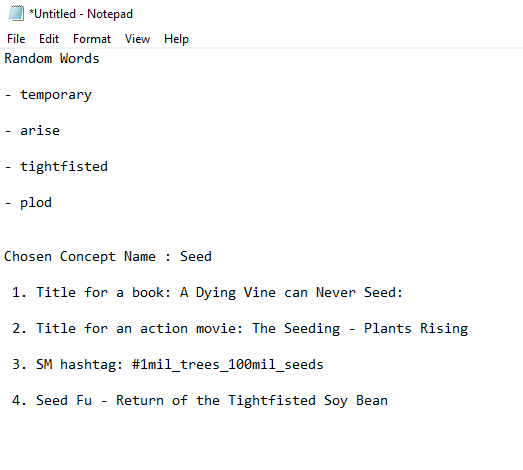
So we had consults today and were given another exercise, I’ll start with the exercise first. So the goal was to use a random word generator, and combine each word generated with the concepts we generated in the initial brainstorm process. So here are the Random Generated Words.

So if you read my previous link I’ve been having difficulty coming up with concepts.
So far I have two major ideas with a third, not so developed idea. The history of zero had quite a bit of scope for a somewhat narrative approach expanding on what The Samsara is, what people go through from that perspective, what it takes to break the cycle, what that is & what is on the other side and why the concept is based upon it. That in itself is five seperate sections. No idea how exactly I want to execute it yet, its gonna take a bit more exploration to get it. For now, lets call this one concept idea Samsara.
The other idea is Seeds. To give some context I was wondering about instances where the number zero actually means something other than its place holder function, and what I
found is that SEED generators can have zero values, because the base values are connected to other values set by a creator for a particular purpose, zero can mean something in this instance other than nothingness. This idea actually came from Xiaohan Zhange’s work with fractals and how the use of letters would make alterations in the seed of the fractal generator. Lets call this one Seeds.
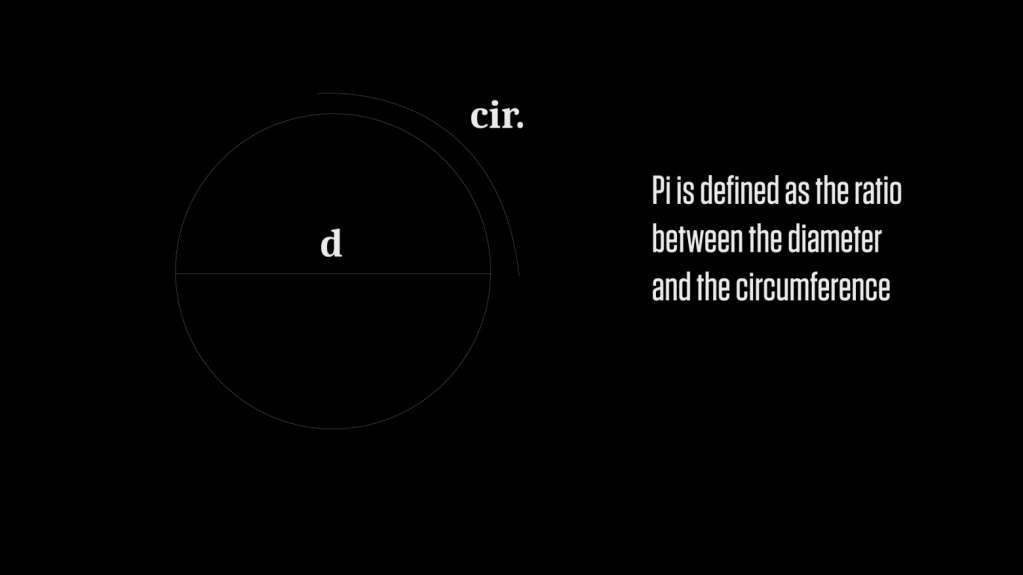
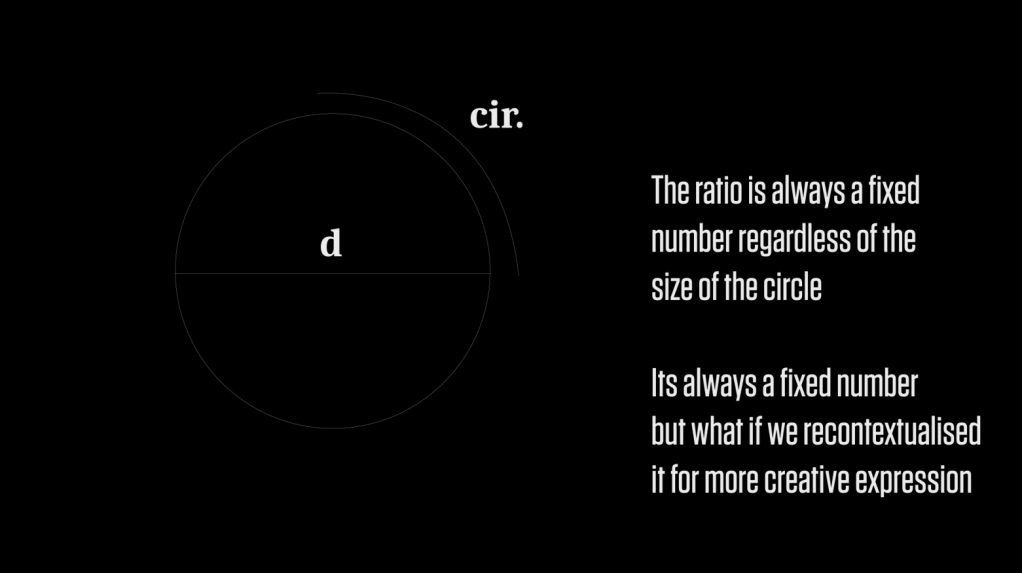
The third one is more of a different take on the seeds idea. Basically, there are numerous numbers out there that have incredible amounts of significance to the natural, physical, technological, financial & economic aspects of life. Pi which is the ratio between a circles circumference and its diameter, which is always a mathematical constant (which is mind-blowing because its an absolute rarity among abstract or even pure shapes for there to be any constants for geometry), Euler’s Number (or constant) which is the base of the natural logarithms and is the only number whose function is equal to its derivative which is often referred to most in financial calculations for compound interest. There’s the Fibonnachi sequence, in which the next number in the sequence is always the sum of the two previous ones behind it provided that the first number in the sequence is not zero. This sequence appears in nature all the time. There’s the speed of light, I don’t have to explain that one, its the speed at which light travels and because nothing is faster (debate-able seeing as nothing has been observed traveling faster) its a freaken universal constant no matter where in the universe you are. Points is, there are numbers that are really important but, of course, in context with my zero draft, it is important to note that these numbers have their significance embedded in their context, but what happens when you take them out of their context, do they yield equally interesting results? The goal of the experiment would be to plug those numbers into a seed generator for some sort of primitives generator and see what happens (I have the perfect one in mind: will elaborate later).For the sake of the exercise, lets call this one critical numbers.
1: Buddha kept a deadpan face at the fool who couldn’t grasp Samsara.
2. Let me enlighten you out of Samsara.
3. Squirrels never leave Samsara
4. The enlightened one is never determined to leave Samsara, that happens as a consequence of his virtue
5. Samsara is an illogical, deafening roller-coaster that never ends.
6. Deadpan poker player never truly sow the seeds of trust in anyone.
7. Seeings seeds grow enlighten us all about life.
8. Squirrels don’t just go for any seeds, but the ones they can store.
9. How a seed grows and propogates, is determined by how its treated
10. Torrents deafening speeds is dictated by the number of seeds.
11. Only deadpan numberphiles love critical numbers.
12. Critical numbers enlighten the one who seeks to know the fabric of the universe.
13. Squirrels hoard in critical numbers.
21/04/2020
I got notification that some of my updated material is not quite visible on the blog from the date 17/04/2020 but for some reason, its all still visible to me, please let me know if these screenshots have made it onto the blog.


22/04/2020
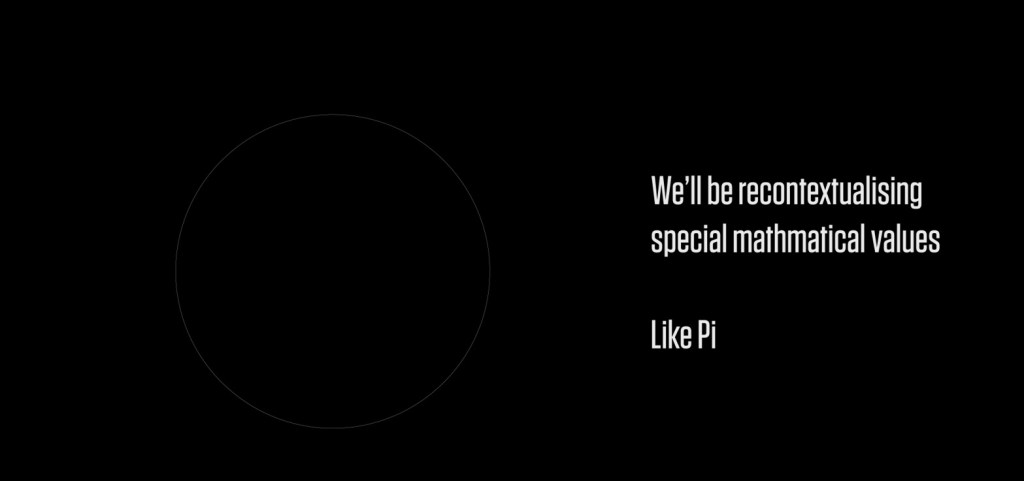
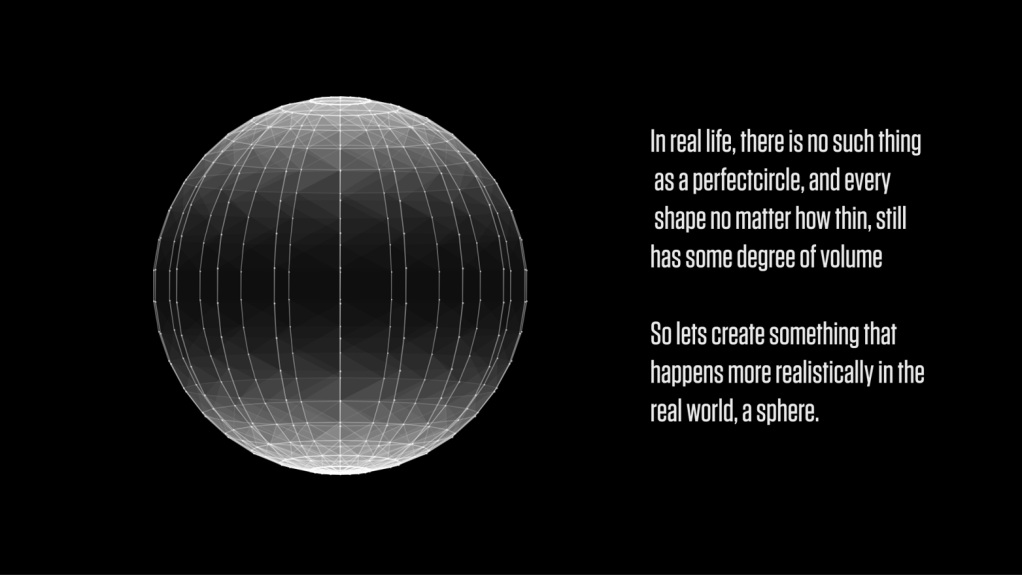
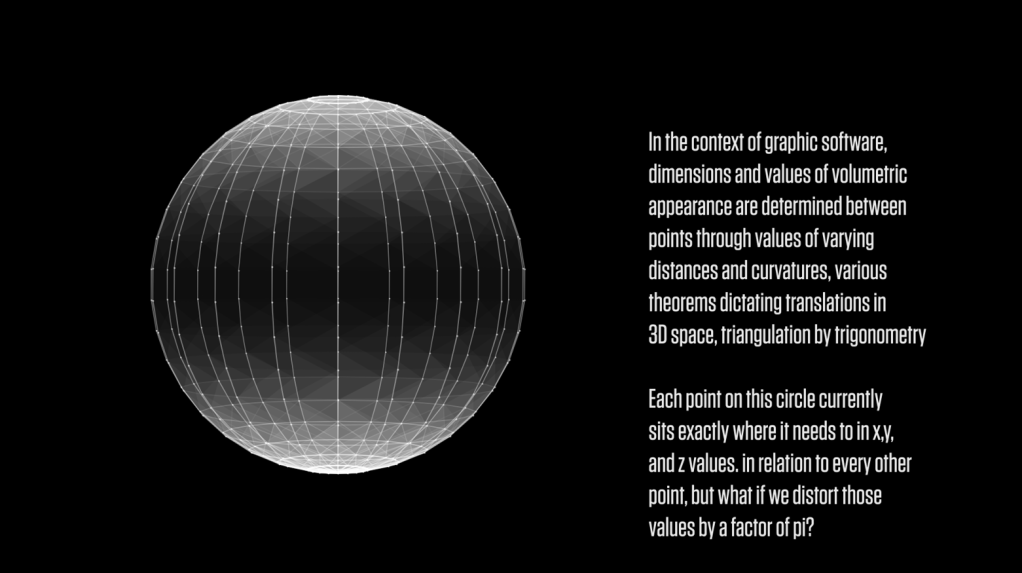
I’ve had to uninstall and reinstall some of my Adobe programs, some I couldn’t get to start up for some reason and others would cause severe ram usage spikes that would slow down my pc to an absolute crawl. This puts me a bit behind on the timeline of things, but I now have a direction significant enough to go on. I know that I have a certain strength when it comes to abstract motion graphics, so I will be applying what I know there. More details to come, but for now, I will be focusing on what was discussed in my first consult, initially, my first idea was to create everything using a plugin called plexus, because it defines everything in values of points and translates everything within expressions of triangulation which makes it extremely versatile, but I was told that it is extremely limiting to the brief to use only one plugin, so I will definitely be looking for more that have similar potential for use of generating unique outcomes with numbers. I was asked, what would some of these creative expressions of re-contextualized numbers look like and how would I make them work? Short answer is, I don’t know, and that is the beauty about it, the outcome is completely unknowable until the experiment is done. The thought process comes in about where to plug in the numbers and not what results from it. But for the purpose of giving you an idea of where I am going with this, here was a re-contextualization of pi as discussed within consult.

That was the explanation, below is what it is in practice to its simplest degree.

Retro-active Post (Internet Connectivity Issues)
25/04/2020
Mass-update: In our last consult, I displayed how I can show the beauty of significant numbers through the use of computer assisted graphic elements via plexus, where I left off was the search for various other plugins and effects that allow me to express numbers as effectors for visual elements. In my search, I found 2 major ones:

And…

Why am I using them? The trapcode suite of graphic tools have an incredible scope of interlinking with After Effect’s in-built system of effectors such as that of un-tasked sliders, buttons, knobs, and expressions. I’m using both because they have two slightly different intended uses and ways of functioning.
Trapcode Tao is one of the youngest additions to the suite, and its on-site description completely undercuts what its capable of doing. Firstly, it generates 3D geometries along paths (which can be pretty restrictive because paths are 2D, but that isn’t really a problem that has any bearing on my project as I have ways around it), as stated, but what it doesn’t tell you is that it can also use an in-built fractal generating system for the purpose of random geometries that aren’t linked to pre-existing paths which is absolutely brilliant if you are trying to create something that mimics organic movement but this is only the tip of the ice-burg, in fact, you can skip both the using of paths and fractals, and just use lights (with a specific naming convention) to create generative points.
You can mess with textures and assign custom ones created within after effects (they can even be animated), and because it actually exists with the After Effects 3D space, it can take and be effected by the in-built After-Effects lighting system, and despite its potential for becoming something with high complexity really quickly, everything loads in damn fast. You can make some seriously beautiful things with it, below are some of the tutorials that informed me exactly what this thing is capable of.
Of course, me being me, I latched onto the first thing that would make my job a million times easier – the fractal generator. Let me clarify: I do not think its anywhere near a completed aesthetic, nor do I think I’d get away with presenting it as one. This is me playing around with its systems to understand how the thing works. Which I explored for all of about thirteen minutes… and then got incredibly bored of the aesthetic. I thought about beautifying it, but you know the old adage ,” polish a turd and you get a polished turd.”
So back to task at hand, how do I express the beauty of mathematics through the use of this plugin? I needed a number for this one. Originally, I was going to take high numbers out of the Fibbonacci Sequence, and plug them into the fractal generator above, giving each fractal some time to express the seed of that number before dying, which could be conceptually interesting but it would probably look like the experiment above which is visually detestable, so I revisited the tutorials. When I was going through the second tutorial of Tao by the Red Giant channel (they are the guys that made the entire Trapcode Suite), they explained that Tao can use “replicators which would automatically take the qualities of the original Tao” which gave me the idea of potentially expressing not a number at a time, but a sequence of numbers. I got so wrapped up by the Pi explanation, which is the representation of a single number, that I got locked into the idea of expressing one number, ratio, equation, proof, mathematical model, etc… at a time, but I don’t have to do that. I can express an entire sequence.
You may or may not know about the Fibonnacci Sequence of numbers. For those who don’t know, the number following where-ever you are in the sequence is the sum of the two numbers behind it (e.g. 1,1,2,3,5,8,13, etc etc) which is significant because the ratios between two numbers in the sequence closely resembles (but is not quite exact to) the logarithmic spiral, aka the golden ratio (the spiral arrangement found repeating in nature of the seeds in a sunflower for instance follows this arrangement, but the man made pyramids do as well).
The video above contextualizes the Fibbonacci Sequence in a very interesting way, definitely worth a watch if you have an appreciation for sound, sonics, music or nature.
I got to work on expressing the spiral in visual terms.
27/04/2020
So I’ve been going complete boss-mode in After Effects to get some incredible content for the first section, challenging myself to find out all I can about the new tools in my arsenal, only upon completion to find that Media Encoder would not accept the file into the cue for whatever reason. Research around the error came up with no potential solutions, so I scratched the afx file and started anew (which retrospectively, I shouldn’t have done, you will see why later), which really added to my nihilistic sense of this whole damn situation. No need to mention how badly this stressed me out, it pushed my entire schedule back by a day and a half, which is something I can’t afford with so many briefs running at the same time. After an uninstall & subsequent reinstall, everything seemed to work out fine (turns out there was a small condition to it working but I’ll explain later: the problem crops up again). So I chucked it into vimeo, and waited… and waited… only to realise that my pc bucked the connection because the signal strength had dropped through the floor. Murphy’s law, huh. Anyway here it is:
27/04/2020
So I had already consigned myself to doing Pi as my section 2. Why? The work (research part of it anyway… in highschool) had technically been done, in fact, I did an entire explainer above for every aspect of pi and how it was going to potentially effect the outcome of the visual experiment (albeit at a single amplitude of distortion, but in this experiment, I might do three or for different amplitudes, ranging betweeen + and – numbers), all that was left to do was to illustrate it.
For that end, I am using plexus, a plugin that I have been well versed in since the Samsung Galaxy S3 came out, or at least the ad for it. This was the ad that got me into motion graphics to start with. Let me show you:
It hasn’t exactly aged as an ad all that well but it is still an incredible plugin with incredible capabilities. To give you a breakdown of what is does, it is essentially a points, lines, facets, and triangulation generator that takes modifiable rules, such as the minimum distance between points for a line across them to be generated and how many points are allowed to be connected together to determine what the visual outcome is going to be. As simple as that sounds, it opens up a lot of possibility for playing around.
I believe its intended purpose was to create a simple visual tool that can be used for data visualization but its inception has created its own digital, futuristic style, so much so, its used for creation of futuristic UI. New additions to its capabilities is the introduction of group actions and the utilisation of 3D obj files to position point locations, but we don’t need any of that for what we are about to do.
So how do I intend on doing this? I’m going to be using primitives to create a circle. What is a primitive you ask? A primative is basically a shape of extrapolated points that sit in space in such a way that the shape is technically perfect. Why use a primitive to create a circle? Humans do not have the precision to guide points manually to create a perfect circle in an acceptable amount of time (can you imagine doing the math for every point, guaranteed insanity) and the only way to do it manually in the first place is with AFX lights, which is great for more random or organic things but not perfect shapes. I will then take this perfect circle and create a sphere from the repetition of that circle around a common axis (center-point x-value of the circle, along the y-axis), I will then use the distortion function to randomise the position of points by a seed factor of Pi, then use varying amplitudes to shift that distortion to new values, both subtle and extreme.
27/04/2020 II
Here’s a snapshot of how its going so far


27/04/2020 III
Export completed with no apparent issues, thank God. I’ve uploaded to Vimeo, as soon as it’s done, it’ll be on here to grace your eyeballs with mathematical beauty.
27/04/2020 IV
28/04/2020
After the above-mentioned debacle with attempting to export the first sections motion graphic, progress into section 3 was slow, motivation was down, and choosing a number to represent it that would have as cool as the previous one was proving to be extremely difficult. Until I stumbled onto Shoddycast, a youtube channel in which they take video games to deconstruct the feasibility of certain in-game mechanics, physics, effects and other cool stuff using physics and math models. Nine times out of ten, its literally just one person tearing a new one into the design choices of video game developers, but its humorous and can be quite educational if you can get past the almost constant blaspheming and swearing.
I was watching one just to get my head out of the rut its in, and I stumbled onto something very peculiar, an apology for misrepresenting a physics concept to explain why laser weapons are absolute bullshit (unrelated to the following but is worthy of exploration on its own), and the nature of gravity and why light should seemingly be unaffected by it. Here’s the video. Worth a watch if you want to get some of what is mentioned here as it actually pertains to the next section.
You see, Isaac Newton’s definition of gravity is one of a force, and forces can only be exerted upon things that have mass; light has no mass, and yet it has been observed that a path that light takes can be bent around a gravitational entity massive enough (black holes seemingly do this with ease). This shoots bullets through Isaac Newtons concept of gravity. In comes Albert Einstein, telling us that our concepts don’t quite hit the mark, and he gives us the special Relativity theorem (E=Square root of [m^2 x c^4 + p^2 x c^2]) which is simplified to E=mc^2) which is the theorem to plugin for objects that have mass but aren’t moving, but light finds itself in the opposite boat: it travels damn fast but has no mass. To give you an idea of the components, E=energy, m^2=change in mass, the p^2 is momentum, and c^2 is the speed at which light travels. What you are left with in the case of light is E=pc, which is simply telling us that light, has an energy value of the product of momentum x its speed, and as such gravity must act on one of these values in this equation. We know that gravity cannot act on the speed of light because it is a universal constant in the universe i.e the speed of light never changes regardless of where it is in the universe, so it must be acting, what on either the momentum that light imparts when it comes into contact with matter (but this cannot be the case because even if the gravitational force of a black hole is being exerted onto light, gravitational force is not itself mass or matter). Gravity cannot effect energy directly because energy itself is not a thing, and if momentum could be effected, it would add to it, ultimately adding to the speed of light which we know is not possible… so what gives? Einsteins theory proposes that gravity itself creates ripples and dips in space-time, the very fabric of space and time is being warped by gravity, warping the direction that light takes *mind-blown*.
So what does this have to do with the numbers experiment? Warping is a staple of After Effects, so much so, the distortion category of effects is on of the largest in-built categories in the software program. It wouldn’t be too hard to demonstrate the principles above using a particle generator to simulate light travelling and a warp-effect or two on an adjustment layer to simulate gravity’s effect on light. It also gives me the chance to play with…

(I swear this isn’t a paid promotion of their products, their plugins just allow me to do such cool stuff that wouldn’t be possible in afx alone)
Trapcode Form does very similar in a sense a to Particular, with a few minor differences; there is no death or birth rate of particles, and the particles are always projected in a field of sorts. It is the second feature that I am most interested in. So you read that bit about entities with intense gravitational fields or “sinks” warp space-time. Space-time (often believed to be entirely seperate fields) is often represented as a grid or a a field. Using form would be the easiest way to create a detailed field that can be distorted. I will use particular to generate the light streams distorted by the gravitational entity.
28/04/2020 II
I am so done (skip to 05:05 – END to understand)….
28/04/2020 III
After a 30-min break to cool my head, I got back at it. Fortunately no crashes but I ran into the same issue as I did with section 1 – Encoder wouldn’t allow me to export through it, so I opened up a couple of my projects that rendered fine, tried to render them again, no issues, so I assumed it must because of the plugins I’m using, so I remove all the bits and bobs that have a trapcode plugin in them one by one and attempt to render them again, turns out that the culprit is a couple of trapcode plugins, namely form and shine. I went and did some research on why this happens, but no one can give a straight answer or suggest a fix that doesn’t require a rollback (which would mean an inevitable rollback of all the other softwares that would require usage of the one). What someone did suggest however is to use the in-built render, export to the highest settings in the avi format, then use encoder to re-format to mp4, which I did, and it worked aces extremely limited quality loss (what I might do in future is attempt to put it into an image sequence of sorts, string them into a new afx file and use media encoder to re-stitch them).
28/04/2020 IV
Here is section 3’s motion graphic
29/04/2020
Despite losing progress multiple times to finicky software and hardware crash-inducing ram spikes, my consult for yesterday went much better than expected. I got solid advice on how to change up the structure of my website, and because all the notes are on my wireframe plan, I won’t lose em (some benefits to working through a digital medium for consultations). One of the coolest things to come out of that consult was having the likeness of the structure for the website being compared to an interface in Westworld season 3. I am a huge fan of Westworld, watched both season 1 and 2 in one go, but unfortunately haven’t had the time to watch season 3, but to have a concept be compared to the likeness of the third seasons trailer (will be linked below) and that fictional UI that appears within it and to suggest that I explore its visual cues for possible improvements, is massive praise (at least in my book), and what a shock to my system to find that it was (at least in partial) made with one of my favorite plugins, Plexus, was enough to revitalise my enthusiasm for this brief.
On analysis of the trailer, it is more likely that it could be created with a particle emitter plugin like Particular or could be a distorted field from trapcode Form, using a specific custom sprite for the particles being created.

The website, incite, is slightly different, in which it looks like they took plexus and used the point generator exclusively, and either used an adjustment layer with a circle mask to blur the inner particles of the sphere.
05/05/2020 Retroactive Post:
Sorry about not posting for so long, I’ve had a rather limited internet connection on Friday, and no connection whatsoever during the weekend. To outline what has been going on, we had another consult, the suggested details were as follows:
- Be more visual with numbers (include them into the visual structure of each video)
- With regards to the website plan, make a few subtle changes, and start coding
Out the gate, it meant that a few changes were needed to be made all existing and future videos… cue the extra work montages
The first thing I did was go back to the first video I made, the one about the Fibonnacci Sequence, and included the numbers of the sequence into sections of the video. The sequence get exponentially larger the higher up you go, so eventually I had to get a sequence generator to run the numbers for me while I tried to place them into the motion-graphic (you will see it in the screen recording). Of course, sequences run into forever but my video has a start and an end, so I had to decide how much effort I’m gonna expend to get numbers into the video and as such, I decided to space out 25 of the first numbers across the length of the graphic and also put the expression stating that it is a mathematical expression that tends to infinity.
The next thing I did jump straight into getting my second section video done. Somehow I needed to express Pi into the motion graphic, but taken the number is kinda impossible because its an irrational number (one that expresses itself in an infinite number of pre-decimal numbers, in other words, it cannot be expressed as a fraction). Fortunately, there is a symbol that expresses it in its entirety. Plexus is capable of taking obj files to drive its animation, so I found an image of the symbol-Pi- and traced it, saving that file as an Ai-8 file which can be taken into Cinema 4D, as a spline. I then extruded the aforementioned spline into a 3D shape, exported that as a wavefront obj and bobs ur uncle, we are in business again in AFX.
From that point, it was a back and forth battle in finding the right degree of expressional accuracy for the points in Plexus (for whatever reason, plexus did not accept every point created on the original spline, so it wouldn’t generate points for every space necessary). After playing around with line draw distances, point sizes and number of connections per point, I eventually got to a point where it created something that somewhat resembles Pi (non-intentional outcome to have it draw more connections than necessary). The last bit of animating this work was to distort the shape by an amplitude factored by pi (or at least the first 4 digits, it wont accept anymore decimal numbers). I went back and forth between positive and negative amplitudes, varying whether or not triangulation or facets where turned on, varying the distance that those effectors would appear, etc. Finishing touches were to add a camera on which I could alter the depth of field, I then overlay’ed some chromatic aberration to make it more appealing (glitch aesthetic).
A day later, I have to jump into section 3’s video, but this one is a lot more complicated than either of the two before it. This one is not of a single irrational number, its a formula that several mind-shatteringly large numbers in it (that also happen to be irrational), and condensing a formula into a motion graphic just to make it relate to the overall brief does not guarantee that its going to be understood, or even make visual sense, but I tried anyway (spoiler alert: I gave up cause I couldn’t make it work).
After realising that it wasn’t working out, I opted for explaining the visual elements that are representative of the elements within the actual formula. A y-axis grid of particles that is representative of time, an x-axis grid of particles represent time, making a unified space-time field. I put a distortion/spherical force in the center of the grid to simulate a black hole which is one of the only forces capable of distorting the field enough to make even light bend in response. The particles that streak across the entity is then a representative of light moving in one possible direction, you get the picture. Unfortunately, my recording software bugged out, so I couldn’t display my process, but I will link the final asap.
Now for the last two: Euler’s Number and Kirchhof’s First Law
Lets start with Euler’s Number. As mentioned in an earlier post, Euler’s number is considered the ideal ratio in financial maths. Why? It’s importance is most of associated with the point before which the increase in number of times interest is compounded while the interest is divided into half its original value, resulting in diminishing returns. But this doesn’t only occur in financial maths; it turns out that by chance, many things hold Euler’s Number as the median guiding point before diminishing returns can occur. It is thus considered the ultimate median point.
If we are talking about median points, what is a more recognisable instance of visualising medians than those digital audio visualisers on old-fashioned music-orientated home studio systems and boomboxes? In a similar vein to Pi, Euler’s number will be used to drive the amplitude of the animation, but the animation drive itself will be music. That’s right, I’m making an future-orientated but old fashioned audio visualisation, through the use of soundkeys, which analyses the waveform, converting its output into pic-whip-able effectors. Unfortunately, due to its demand though, I won’t be recording this one. I will put up the finished product though.
Last one: Kirchhof’s First Law
The only instance where anything divided by any other would be equal to 1.
That’s not exactly true, but it works out to appear that way
Kirchhof’s First Law has to do with the conservation of current in a closed system, provided that there is no change in charge. The sum of current entering any point in the circuit should remain the same as the sum of current exiting the circuit. Why is that important? Every device plugged into a multi-socket plug is demanding energy coming through via current, if this law was non-existent, it wouldn’t matter how many free ports you had, you could only ever use one at a time (and it would most likely overload everything you’ve ever wanted to charge).

 MM3 - Anton Gollia
Hey Anton, hows it going? Any updates?
LikeLike